In 2024, I answered a call to go back to South Africa to join the Track Your Life retreat at Londolozi, hosted by Boyd Varty, the author of one of my favorite books, The Lion Tracker’s Guide to Life. On the day before that retreat, I remember waking up in a hotel room in Cape Town from a weird, vivid nightmare. An old, ugly snake covered in old skin was following me around as I desperately attempted to kill it. To my despair, it wouldn’t die no matter how hard I tried to smash it with a stick. It kept following me until I realized it meant me no harm, but it was not going to leave me alone.
Since joining the Track Your Life retreat, Africa has become the stage for some of the most important and life-defining moments of my life in the past two years, as I’ve spent over six months on the continent across multiple trips.
It has been a call from the wild to go deeper into the inner part of the regenerative work I’ve been doing for the past ten years. It’s now clear to me as the Western Cape sky in a dry summer month, that there is no way I can properly lead regenerative work on land without looking at what needs to be rewilded inside myself.
It also explains most of my past failures as an investor and entrepreneur in this field. Brilliant regenerative business ideas look beautiful on paper, but the unhealed, domesticated egos driving these ventures, including my own, often get in the way and prevent many projects from thriving. The unhealed patterns of our lives make our inner soils poor and infertile for dealing with what is arising and trying to flourish.
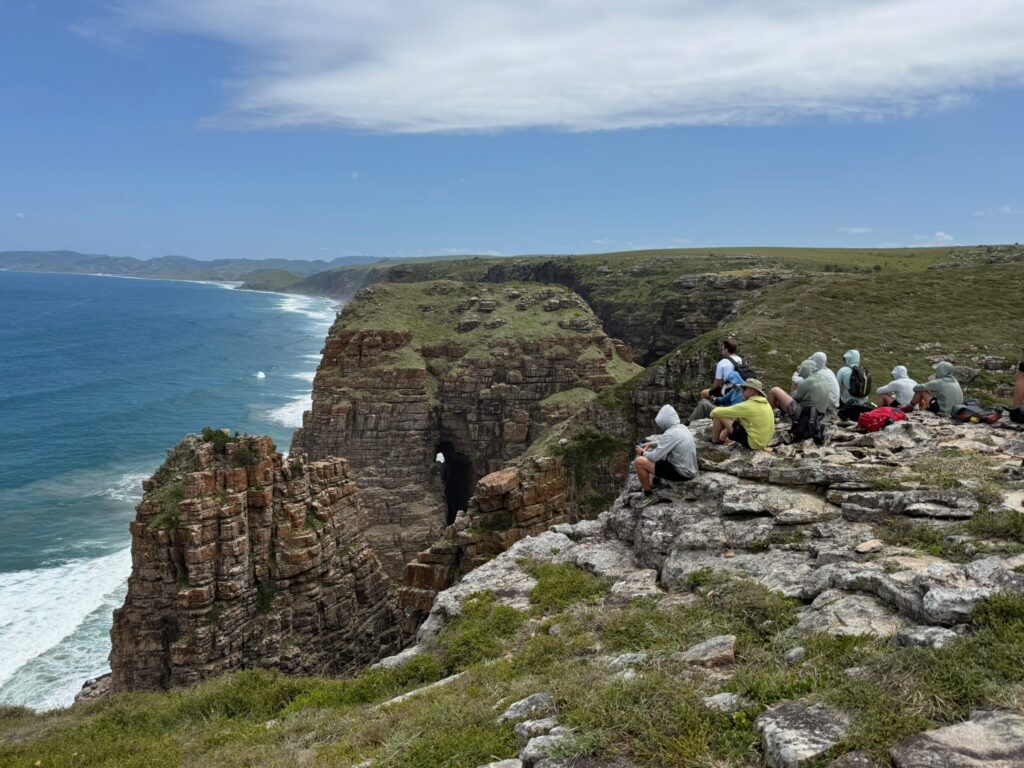
Two years after tracking lions around the Sabi Sands Reserve in the beautiful, abundant land of Londolozi, a new call to join Boyd in another wild adventure arrived. It was an invitation to join his new retreat. A small group of guys who attended the Track Your Life retreat would join him on a trail through a remote part of the South African coast called the Wild Coast. With elements of ancient rites of passage, we would walk for five days away from civilization and our regular lives. There would be no phone signal, just wild nature and a group of men moving together. It took me some time to say yes to this call, as I had committed to leading a group from Australia to the Amazon. But, as often happens when life starts working for you, the trip to the Amazon was called off just in time, opening space in my agenda to take one of the last spots on the retreat.
I flew into a small, little-known airport close to the border of what was once the “independent” region of Transkei. During British colonial rule, strong resistance led by the Xhosa people who still live on these lands resulted in colonial powers isolating the region. Later, the apartheid regime designated it as a Bantustan, where tribal people lived without proper South African citizenship in pockets of poverty, serving as a source of labor for the mines. As infrastructure such as roads and ports expanded across the country, it purposely went around the 43,000 square kilometers of Transkei, an area roughly the size of Denmark.
As is still the case today, the N2 highway leads to a dead end in Port Edward. That is where we met and stayed for the first night before later walking through the section of Transkei called Pondoland, the most remote and isolated coastal area of South Africa.
Fourteen of us met at the Estuary Hotel, most of us for the first time in real life after only one Zoom introductory meeting. We met Boyd and Richie, who would lead us on the Pondo Trail with the support of Wild Child, a local operator that takes adventure travelers on the trail and manages campsites along the five-day walk between the Mtentu River and the Mbotyi River.
The adventure would start, weather permitting, with a Zodiac raft trip from the closest beach to the Estuary Hotel to the start of the trail. It would be a two-hour boat ride.
As we gathered in the morning to prepare our gear for the start of the trail and our last hour of phone signal before heading into the wild, we looked at the ocean with a sense of relief, our bellies full after a hearty South African breakfast. The ocean looked much calmer than the day before, when we had gone for our first swim. The boat trip would be possible, sparing us a three-hour muddy, bumpy car ride through the rugged dirt roads of inner Transkei.
We met on the beach with our carry-on packs for the day and received instructions from the two Zodiac captains. We would need to work together to push the boats into the water through the waves. It had the familiar feeling of a military operation straight out of one of the war movies I loved to watch as a teenager. No one was going to shoot at us, but we were about to embark on an adventure, as we would be dropped off in the wild to begin our trail. We managed smoothly through the waves and minutes later found ourselves surrounded by dolphins on the open sea, ready for the first of many wild swims of the trip.
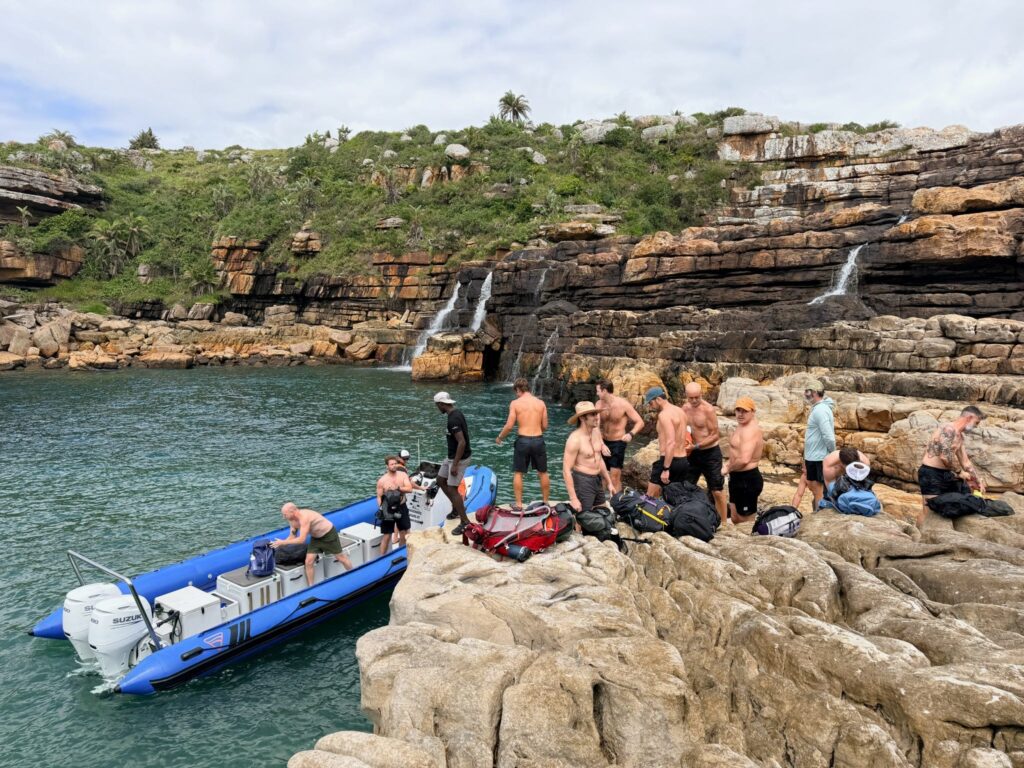
As we approached our landing spot, we passed through the incredibly beautiful sight at the mouth of the Mtentu River, one of the largest in Transkei and its former border. The Mtentu River is the playground of one of nature’s many mysteries. The giant kingfish of the Indian Ocean, sometimes measuring three meters in length, gather once a year in summer in large schools at this site. They swim several kilometers upriver to an area where they circle for days before returning to the ocean. Scientists have puzzled over this mysterious kingfish pilgrimage for decades, and no scientific explanation for the behavior has ever been uncovered.
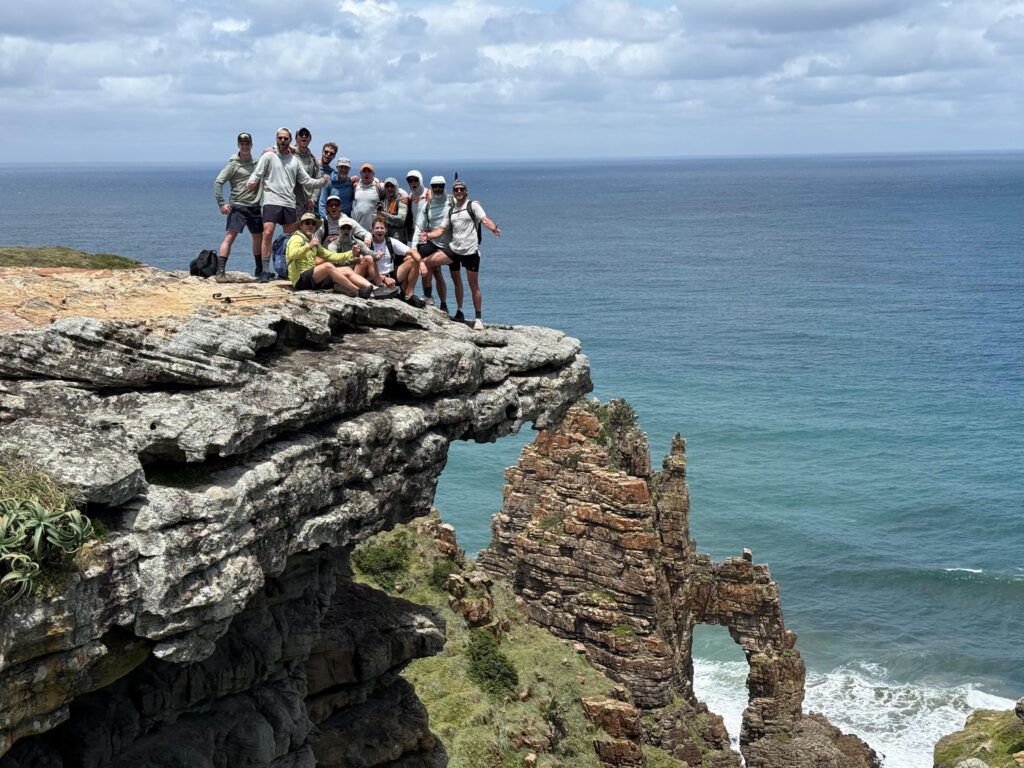
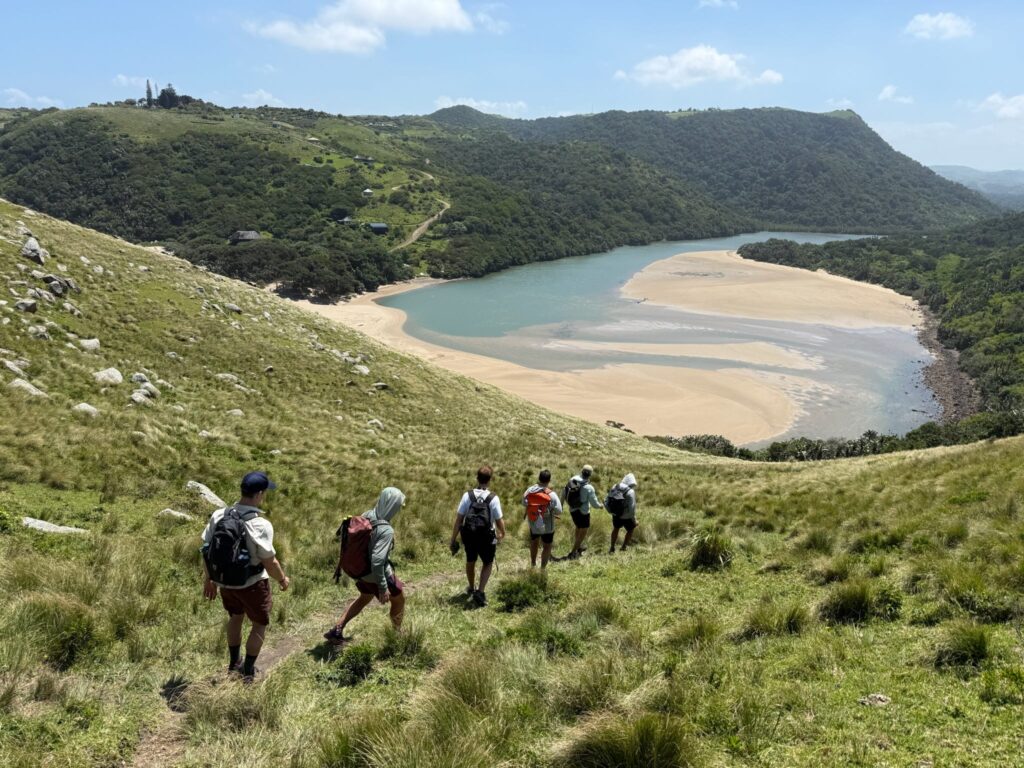
We were dropped off at an incredible location, swimming from the boats to rocks just above a small cascading waterfall. There, our guide Ash led us to the first baptism of the Pondo Trail. It was our first of many cliff jumps in jaw-dropping landscapes. With our sneakers wet from swimming and cliff jumping, we started our trail. The first day was shorter, but the plan was to walk an average of 20 km per day through ocean cliffs, grasslands, and bushy forests. The instructions were that we should move through the incredible wild landscape of the Pondo Trail, fully present and watching out for ourselves and each other, while Boyd guided us through daily coaching sessions in nature. It all aimed to facilitate our reunion with our own wild selves. Many of us, like me, had long lost that part in high-rise offices in front of digital screens in cities like London, New York, São Paulo, Johannesburg, or Hong Kong.
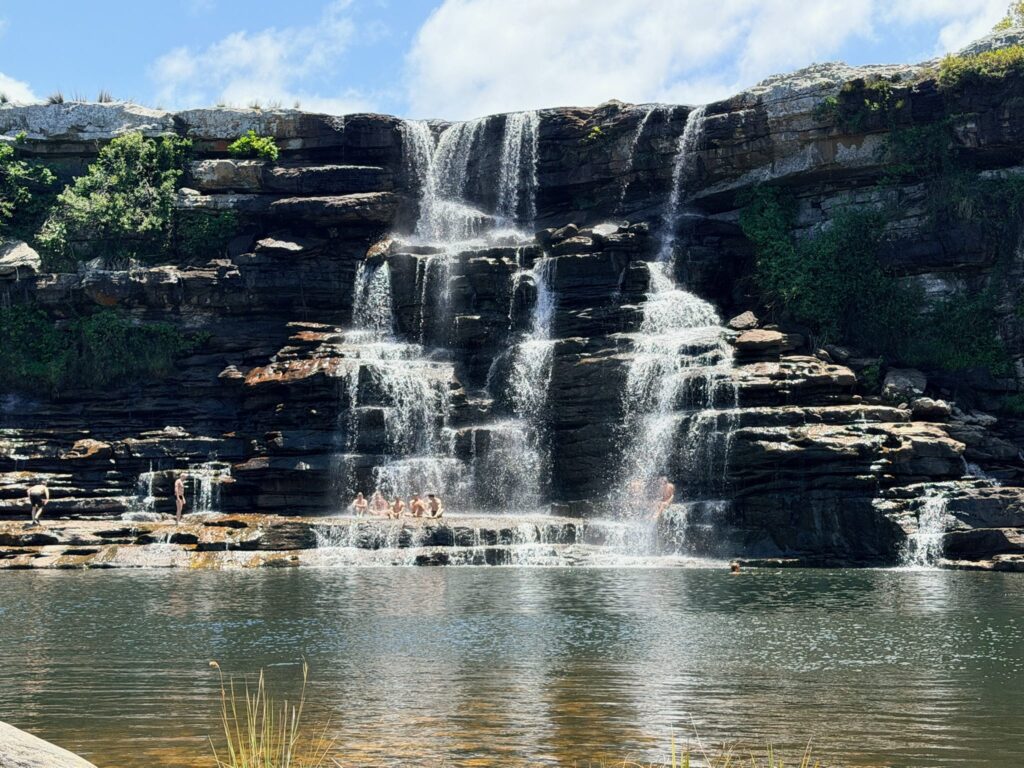
Our days started early at the campsite at sunrise with breathwork guided by Richie. Then we would be on our track, walking and talking, or staying back for stretches of silent walking with ourselves. Breaks were usually taken by beautiful rivers and lagoons where everyone eventually met in the water. Sometimes we simply threw pebbles into the lake like we did when we were boys. Conversations on the trail were often cracked open, deep, and heartfelt. Something sacred emerged as men bonded over a common path, feeling held by the wild.
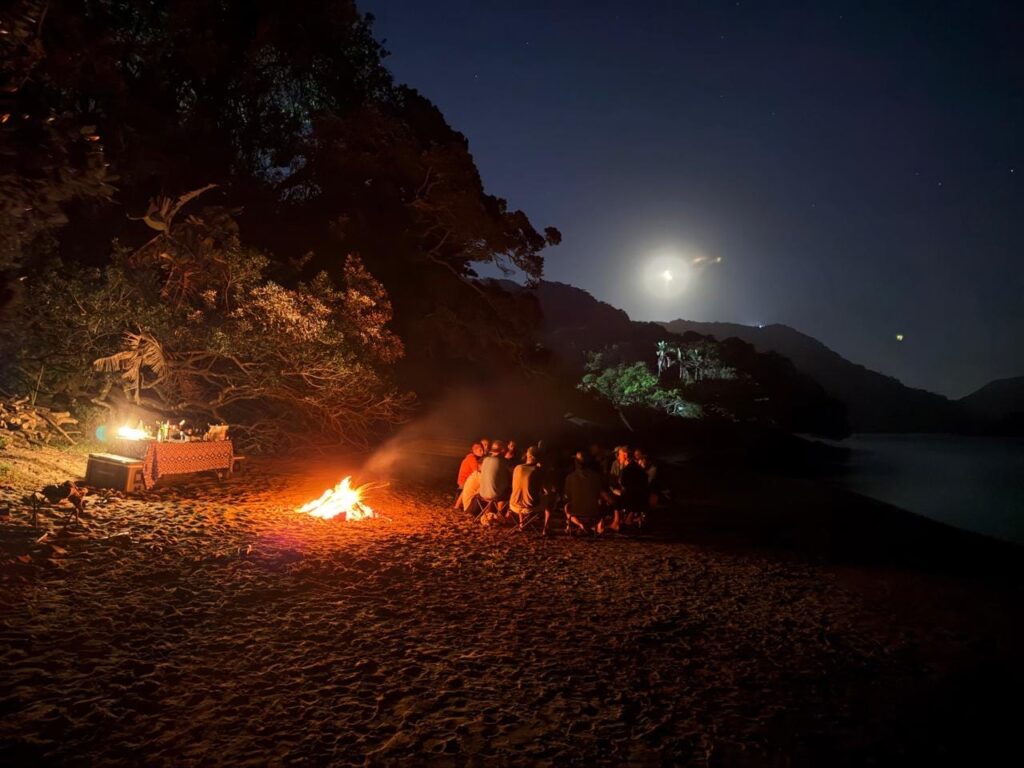
As we made our way to the next camp, worn down by the South African sun and the long walk, the attentive Wild Child team would be waiting for us with a cold gin and tonic. Yes, drinking and bonding around the fire was an important part of the experience, as was sharing our stories. Some came straight from the college locker room. Others verbalized our deepest personal wounds that, as men, we carried hidden deep inside ourselves, usually disguised by the social mask of the tough man who has everything under control.
On our third day, Boyd asked us to walk in silence for the first couple of kilometers. We were led to one of the most beautiful sections of the Pondo Trail, where high cliffs meet the untamed sea currents of the Eastern Cape. This is the site of countless shipwrecks and survival stories from centuries of colonialism. From the Portuguese to the British, the currents of the Cape relentlessly smashed ships full of riches and people, foreign to this land, onto the rocks of this shore.
One of these shipwrecks involved a British ship carrying Betsy, a seven-year-old girl with white skin and blue eyes. She survived the wreck but lost her entire family. The surviving sailors abandoned her alone on the beach, where she was later found and adopted by a local tribe. As she grew up and integrated into the tribe, she married a young prince and became a figure of local folklore known as the Sun-Burned Queen. Legend tells that she would periodically remove herself from the tribe and disappear alone for a few days to meditate in a cave near where her shipwreck had taken place. The cave became a place of reckoning with the life she had completely lost and left behind, and the new life that had unfolded for her.
As we walked toward Betsy’s cave in silence, the invitation was to reflect on what we wanted to leave behind there. What no longer served us from the past. It was not about rejecting a part of ourselves we were not proud of, but acknowledging how that part helped us get to where we are now, thanking it, and letting it go.
Years of inner work had given me a good map of my psyche and illuminated parts of my shadow. I could clearly see parts of myself that were childhood survival strategies no longer serving me as I stepped into a more conscious adult self. I could see them and even verbalize them, yet some kept creeping up in moments of high stress and conflict. They lingered behind me like the old snake in that dream. Refusing to leave. Refusing to shed its old skin. Now it felt like it was finally time for it to go.
We formed a powerful circle of men inside the cave, and Boyd guided each of us through the release process.
The first shadow persona to go for me was the prince. A childish figure that, as a boy, I had assigned the ungrateful duty of making everyone around me happy all the time. The order and priority were everyone first and myself last. When the charming prince failed at his task, a nasty troll lingered behind in my unconscious as the protector. Ready to lash out in rage and chop the head off of anyone externalizing unhappy feelings. As a properly domesticated nice guy, I would of course not let the troll lash out with violent rage at anyone. I repressed it deep within myself, storing it in my body or releasing it only when no one was watching. Both of them stayed behind in the cave, along with the rest of the baggage of my new brothers who supported one another through the process.
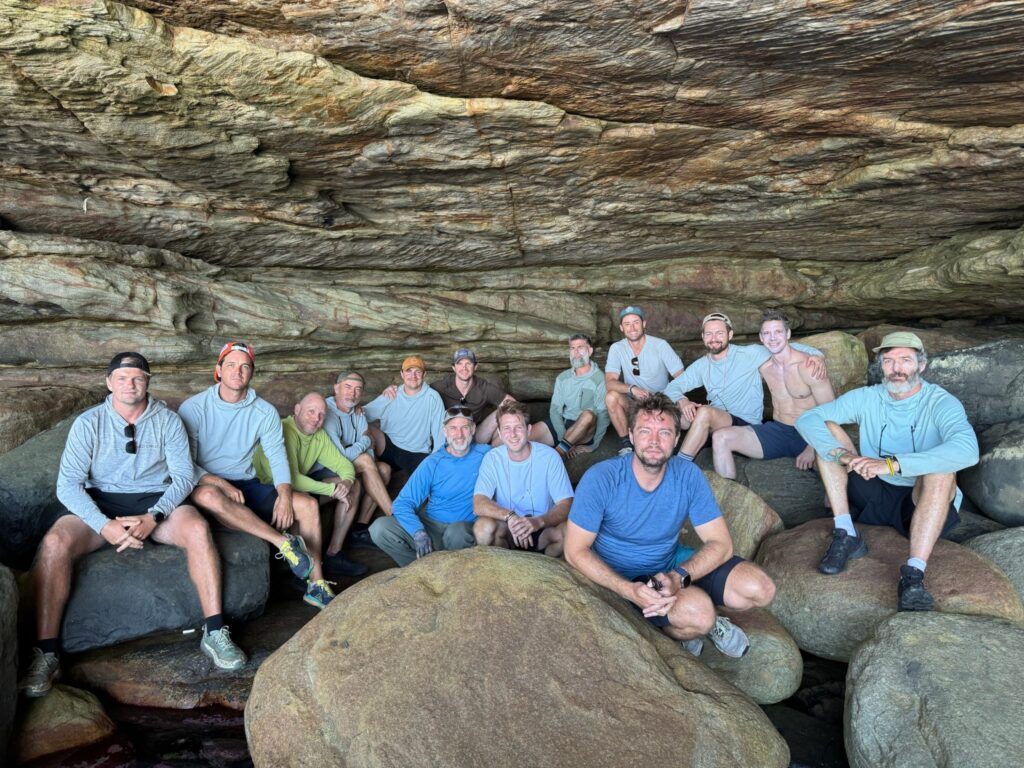
We all left the cave looking like the same group of guys who had entered, but deeply changed.
I wonder if that is what the kingfish is doing here in the Transkei. Shedding old energetic baggage that scientists cannot see with their rational minds. Whatever it is, there is something sacred about this wild coast of South Africa that needs to be preserved.
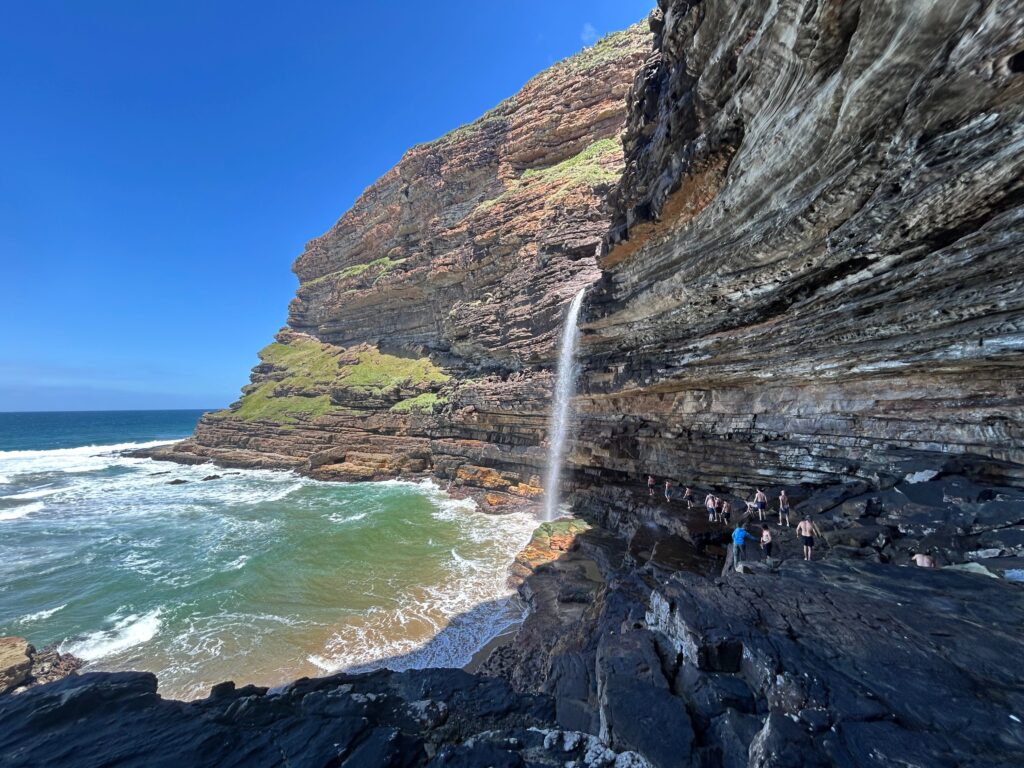
As South Africa continues its journey of healing the deep wounds of apartheid, the modern country is now knocking on the doors of old Transkei, looking to integrate it. A new N2 highway is being built to cross this sacred paradise, now only eight kilometers from the coast. The longest bridge in South Africa has already been constructed across the cliffs of the Mtentu River. It has caused the largest die-off of kingfish ever recorded, as sand from the construction site is dumped into the river without proper regard for the local ecology. Thankfully, the Pondo Trust is raising capital and awareness to place larger areas of Pondoland under environmental protection. This will allow the unique ecosystem, along with the rich culture of the Xhosa people and the many tribes who call this land home, to be preserved.
As I write this back in the comfort of my home in Amsterdam, integrating the experience, I feel incredibly grateful for the Pondo Trail, Wild Child, Boyd and the Track Your Life team, as well as all the incredible men who showed up fully for one another during this wild week free from the digital world. May we all make friends with the snake of change, allowing it to follow us on our journey and help us shed what we need to let go of.
If you feel called to some deep men’s work check out the Track your Life website
https://trackyourlife.co.za/
To walk the Pondo Trail reach out to Wild Child
https://wildchildafrica.com/
To learn more or give a contribution to the Pondoland Conservation Trust